
Introduction
This report emerges in response to the June 2026 shooting at Aylo, Pornhub’s parent company, in Montreal, Canada. The perpetrator, a young man from Alberta, left behind a manifesto that he explicitly hoped would circulate widely and inform future action by like-minded individuals. Rebel News irresponsibly shared the manifesto immediately after the shooting, helping ensure its circulation among wider audiences, including, we would argue, those the author sought to reach on the far right.
While we applaud how much of Canadian media coverage recognized the manifesto’s misogynist underpinnings, we were concerned with some of the ways other media analyses shifted away from this focus on misogyny, minimizing its importance within the discussion of the event. Several right-wing and far-right outlets shifted attention toward the manifesto’s references to communism and anti-capitalism, framing the perpetrator as supporting left-wing politics and attributing the attack to broader “woke” beliefs. SIGNAL network’s senior researcher Dr. Karmvir Padda has clearly demonstrated, in her Conversation article on the shooting, that the manifesto represents a strong example of “salad bar extremism,” which she uses to describe ideological discourse that draws selectively from multiple ideologies while retaining misogyny as its central organizing grievance. We wish to build on Padda’s argument here with an in-depth look at the content of the manifesto shared by the shooter.
SIGNAL’s work as a research network is dedicated to mapping the normalization of misogynist, anti-feminist, anti-queer, transphobic, racist, and extremist content across the manosphere and other far-right spaces. Our specialization in cross-platform and network analyses hopes to demonstrate the movement of harmful and violent ideas from more extremist spaces of social media platforms and community forums, to more mainstream influencer channels, public debate, and policy discourse. We are concerned with how such movement towards the mainstream can contribute to the erosion of the rights and safety of women, queer, trans, and gender-non-conforming communities, and racialized minorities. This report is the first of what we hope will become an ongoing series of reports showcasing research being undertaken through SIGNAL. Our priority is to ensure this evidence-based research is publicly accessible for broad use by various stakeholders. Through these reports, we aim to strengthen collective digital literacy around technology-facilitated gender-based violence (TFGBV), ideological extremism, and radicalization, and the broader consequences these harms can have for social cohesion.
For this report we trace the central grievance – hypergamy – found across the manifesto and link it to similar sentiments within the wider anti-woman digital ecosystem in which it sits. We are interested in the perpetrator’s use of hypergamy to frame women’s sexual and economic autonomy, citing this as the source of current male dispossession. We then examine how this grievance around hypergamy in the manifesto is connected to well-established fantasies of patriarchal restoration, as well as seemingly contested sites of anti-capitalist rhetoric, and misogynist ideas across incel and manosphere spaces.
Tracing Networked Misogyny Across Platforms
Our analysis began by engaging in a close reading and thematic coding of the manifesto itself for recurring concepts, terms or phrases. This process made clear that the manifesto’s central grievance is what the perpetrator calls the “hypergamy state.” Specifically mentioned 111 times throughout the manifesto, hypergamy proves itself as the ideological throughline and grievance purported by the Montreal attacker. The manifesto argues the hypergamy state exists because capitalism enabled women to earn independent incomes, reducing their economic reliance on individual men. According to the manifesto, this economic agency has given women greater freedom to choose sexual and romantic partners. What we found is that throughout the text hypergamy becomes shorthand for women’s sexual, economic, and relational autonomy.
From this we determined where similar language and ideas appeared across broader manosphere and incel spaces. The manosphere reflects a similar fixation on women’s sexual agency as the central driver for men’s sexual and social disenfranchisement, as well as broader civilizational decline. Sexual and gendered hierarchies are a necessary foil within the ideological structuring of the manosphere. In seeking to map and better understand what we see as a longer networked circulation of hypergamy we explored its appearance in digital spaces beyond the manifesto including: SIGNAL’s ManoWhisper database, which houses over 118,000 transcripts of podcasts from the manosphere and intellectual dark web since 2013; Incels.is, an open-access alt-tech forum used extensively by self-proclaimed incels; and the Incel Wiki, an alternative to Wikipedia created in 2018 by incel communities.
Analysis
Hypergamy as a Primary Grievance
Originally used in social scientific discourses to refer to the act of marrying someone with higher socioeconomic status, the word has taken shape in the manosphere, including incel forums, as a stand-in for women’s sexual agency writ large. As the figure below shows, mentions of hypergamy are sparse until 2017, when podcasters such as Jordan Peterson (The Jordan B. Peterson Podcast), Joe Rogan (The Joe Rogan Experience), Marcus Follin (The Golden One), and Nick Fuentes (America First) begin using the term. Like in the 2026 manifesto, these mentions are often in the context of raising alarm around women’s sexual agency. Peterson, both on his own podcast and as a guest on Rogan’s, pushes the idea that women are biologically wired to seek out “higher status” men, which as a result leads to competition and toxicity amongst men. This of course is repeated as a core principle of incel grievance culture. Through their incorrect use of the term hypergamy, members of the manosphere make the case that women’s ability to choose their sexual and romantic partners leads to higher rates of interpersonal struggle, divorce, cheating, and economic loss for men.
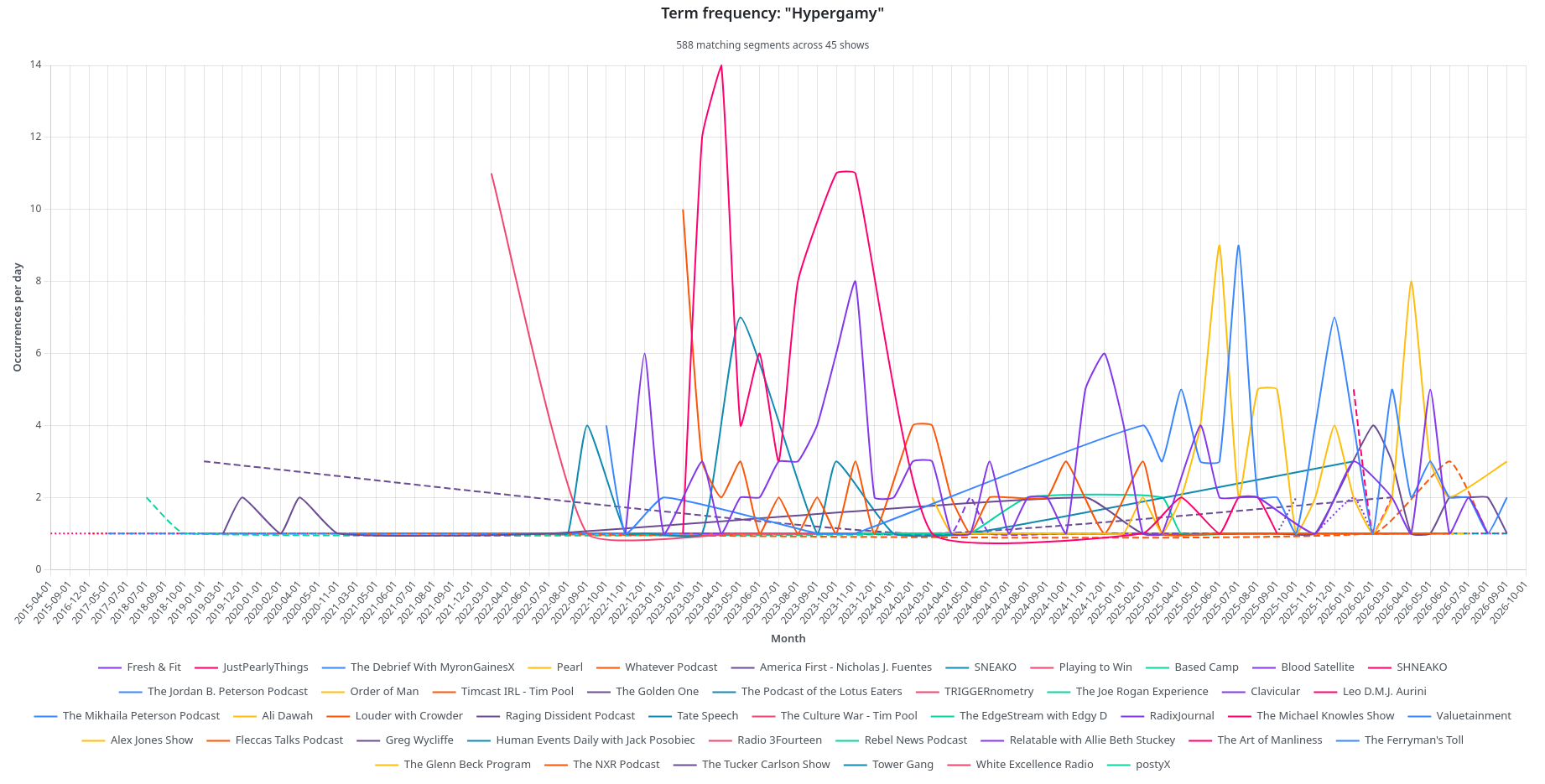
Figure 1: Term frequency of “hypergamy” across 45 shows in ManoWhisper (588 matching segments). Select the chart to explore the data in ManoWhisper.
Oftentimes, when hypergamy is used within these spaces alongside another term – “dimorphism” – or, the ideological assertion of the biological and psychological differences between the sexes. Dimorphism can be used to justify many gender hierarchical beliefs, from the seemingly benign truism that women are more nurturing, to the more serious such as men are meant to be polygamous and women are meant to be monogamous. The appeal to dimorphism is a form of gendered disinformation that enshrines sexism, or naturalizing ideologies around gendered difference, as a justification for misogynist policing of women and gender minorities’ actions.
As Julia Serano argues in Whipping Girl, sexism can be broken into traditional sexism that asserts a hierarchy of maleness and masculinity over femaleness and femininity; and oppositional sexism which separates female and male as two opposing and rigid categories. The manosphere’s appeals to dimorphism and hypergamy highlight the connection between these two forms of sexism. Where dimorphism upholds oppositional sexism, hypergamy upholds hierarchical sexism insofar as it seeks to subjugate women and their sexual agency. This logic positions women and trans* people’s agency as something to be criticized, punished, feared and othered. The outcome is that the manosphere invokes a protectionist hegemonic masculinity that aims to dismantle and vilify feminist progress and appeals to women’s sexual autonomy in the process.
As we have noted, in the manifesto as well as in the eyes of the manosphere, feminism is blamed for the rise in women’s hypergamy, or as we understand it, women’s sexual agency. The Incels.is forum, like countless podcasts in the manosphere, positions feminism as equivalent to the downfall of the West. Many of the incel forum posts make the claims that feminism is antithetical to scientific and social progress and that it enables women to be inherently duplicitous, working against men’s best social and financial interests for women’s gain. Here we see long-standing rhetorical moves to dismiss women as irrational (antithetical to science), untrustworthy, and power-hungry. This is supported by research done by Coufal et al. (2025) who use a word2vec model to track the analogous linkages between words on Incels.is. In their exploration, they discovered that feminism was often discussed alongside themes of oppression, which the researchers attribute to the forum users’ imagined subjugation under “gynocentric” gendered power relations—powered by what they outline as the economics of sexual capital.
This is echoed at various points throughout the manifesto’s footnotes. The attacker pushes the discourse further in the manifesto, arguing that hypergamy and feminism (which he often uses analogously) are also to blame for what he believes to be a “trans epidemic.” Like many users on Incels.is, the manifesto pushes the violently transmisogynistic belief that trans women “choose” transness as a result of sexual/romantic rejection by cis heterosexual women. As studies have shown, incels’ rhetoric against trans women and femmes leaves them at a great risk of violence, a statistic which deserves to be studied and addressed at a greater depth.
The Distorted Discourse of the Marxist-Incel Nexus
When the Montreal attacker’s manifesto was shared by far-right outlet Rebel News and disseminated across media spheres, the focus on the manifesto’s incel origins was diluted and transformed. After a couple of days, the media began focusing on the references to communist texts and anti-capitalist sentiments espoused by the writer of the manifesto. In our exploration of misogynist Instagram posts responding to the shooting claimed that the biased “left-wing media” was hiding the attacker’s communist identity behind claims of inceldom. A cursory read of the manifesto might lead one to believe that the attacker’s primary preoccupation is with opposing capitalism. However, we argue the manifesto instead melds blackpill ideology with communist/leftist language. We want to be clear, close readings of the text reveal the attacker’s hatred of capitalism is fueled by his hatred of women and their sexual agency.
The Montreal attacker (and others) center their social hierarchy theories not around traditional class systems, but rather through what they term the sexual class system. This we believe is a crucial distinction. This melding can be seen most potently in the Incels.is forums, where users call for what they have termed Marxism-Rodgerism, a portmanteau of Karl Marx and Elliot Rodger, the Isla Vista attacker viewed by incel communities as a martyr. Marxism-Rodgerism, Marxist-Rodgerism, or Sexual Marxism, is a contested, often satirical, political organizing ideology. First submitted to the Incels subreddit on August 19, 2017, user @Communcel outlines a theory of class that situates “Chads,” sexually attractive men pursued by women, as the bourgeoisie, and everyone else, incels, “common males” as “the dispossessed” (as the Montreal attacker calls them in his manifesto), or the sexual proletariat. Instead of a hierarchical system of wealth and material property, Marxism-Rodgerism views sexual access to women as the structuring principle of a capitalist society. In this theory an ideal “egalitarian” society is not based on an equitable redistribution of material resources but on the redistribution of women’s sexual agency via “enforced monogamy.” It is easy to look at this misogynistic call to action and the posts on the forum and assume that “Marxism-Rodgerism” is a joke (with violent undertones). However, the notion of “sexual redistribution” is highly disturbing. It is also the philosophy used by the Montreal attacker in his calls for his revolution within the manifesto to ensure men have redress for the hypergamy state where they are disenfranchised from their access to women’s sexual availability.
While specific mentions of Marxism-Rodgerism are not prevalent on other platforms, the concept of enforced monogamy shows up fifty-five times across ManoWhisper, with its first mentions being attributed to shows run by Jordan Peterson, Ben Shapiro, and Joe Rogan. In particular, in the episode of The Joe Rogan Experience on which Peterson is a guest, he articulates the exact same logic about men’s entitlement to women’s sexual availability that is found in the incel forums and the Montreal shooter’s manifesto, just in more covert ways. In the discussion between Peterson and Rogan, hypergamy becomes “market-oriented solutions,” current dating culture is equivalent to “polygamy” which they are against, and enforced monogamy is a solution to returning to “harmonious family values.” This somewhat diluted rhetoric (compared to incel forum discourse) is an intentional tactic that both reveals the way women are viewed as nonhuman property and also obscures the real violence and prevalence of the misogyny.
Conclusion: Technology in the Service of Gendered Regimes
Technology occupies a deeply instrumental place in the manifesto. The author explicitly argues that “technology itself does not inherently support the hypergamy state,” but that its contemporary use has contributed to women’s autonomy and, in his view, the erosion of monogamy. This mirrors wider incel discourse. Preston, Halpin, and Maguire (2021), in their analysis of 9,062 incel-forum comments, found that dating apps and social media are frequently blamed for accelerating women’s supposed hypergamy, expanding their access to desirable men, and increasing their “sexual marketplace value.”
The manifesto takes this logic further by imagining technology as a means of reversing women’s independence. Women’s entry into paid employment is presented as one of the main conditions that enabled the “hypergamy state,” because earning independent incomes supposedly meant that women “no longer wanted, or even needed common men as much as they once did.” The proposed solution in the manifesto was automation. The perpetrator calls for robots to gradually replace women in paid employment, leaving men as wage earners and making women economically dependent on marriage again. This echoes findings from our previous research on manosphere memes, where we identified a similar technological fantasy of making women replaceable. In one AI-generated meme, a man walks with a feminized robot carrying a visible fetus while a human woman sits nearby advertising her domestic and sexual compliance. Captioned “Modern problems require modern solutions,” the meme frames male dissatisfaction with contemporary women as a technical problem with a technological fix (Czerwinsky et al., 2026). Further, Christian Nationalist discourse is equally invested in the removal of women from the workforce in order to uphold the family unit. Recent attention has been paid to some of the more outlandish claims made by Pastor Brian Sauvé of Refuge Church in Utah that women should not have access to social media or if they do it should be controlled by a man. In the same “Kings Hall” podcast Sauvé went on record saying what we consider socially normal is “insane”; this includes “living unattached from a male—like a father, then a husband—for lengthy periods of time” as well as women being given the right to vote (Mantyla 2026). Sauvé is not an outlier in this media sphere; similarly misogynist rhetoric can be found in the social media content and online sermons promoted by Pastor Joel Webbon, who has publicly advocated for executing women reporting sexual assault to put a stop to #MeToo (Mantyla 2024), and Pastor Dale Partridge who has, like Sauvé, spoken against the 19th amendment and women’s right to vote (Solnit 2024).
Taken together, our research has identified a recurring discourse upholding a fantasy of patriarchal restoration that seeks a reassertion of more oppressive gendered hierarchies that favor a male supremacist vision. In this view women’s autonomy is framed as the product of feminist manipulation and a return to domesticity and male authority is presented as beneficial to women themselves. The manifesto extends this logic across employment, mobility, and communication. It proposes restricting private transportation because cars allegedly allow women to travel farther to meet preferred partners, while also calling for dating apps to be abolished and social media and internet access to be heavily controlled. Across these examples, technology is valued according to the gender relations it produces. Technologies that expand women’s economic independence, mobility, and sexual choice are treated as socially destructive, while technologies capable of restricting those freedoms are imagined as tools for restoring male authority. When this is read together it presents a world view in which women’s agency is entirely removed and instead they are surveilled, distrusted, and controlled under threat of punishment by male partners. This is a deeply regressive vision that is gaining traction outside of more fringe spaces like incel forums, and is instead being taken seriously by policy directives as seen in the recent Heritage Foundation report “Saving America by Saving the Family: A Foundation for the Next 250 Years.” It is also showing up in the careful construction of manifestos and other texts circulated by violent extremist actors. The viewpoint is thus endemic and adaptable, taking a similar perspective and altering the rhetorical approach to fit the audience it seeks to spread gendered disinformation among.
The Côte-des-Neiges attack demonstrates how misogyny operates as the connective tissue across seemingly different ideological claims. Although the manifesto draws on anti-capitalist, biological, and revolutionary language, its arguments repeatedly return to a concentrated critique of women’s economic independence, sexual choice, and freedom from dependence on individual men. Hypergamy becomes the framework through which these changes are interpreted as male dispossession and social decline. The proposed solutions make this even clearer. Women’s employment, mobility, communication, and access to potential partners are treated as problems to be restricted, while technology, state power, and enforced monogamy are imagined as tools for restoring male authority. Understanding this networked circulation is therefore essential. Misogynist ideas do not need to remain in explicitly extremist spaces to matter. They can be repackaged, softened, and carried into more mainstream conversations while preserving the same underlying fear of women’s autonomy and the same desire to restore gendered control.
Next Steps and Actions
This report comes on the heels of the June 2026 report by the Canadian House of Commons’ Standing Committee on the Status of Women, which tracks the discussions surrounding the rise in antifeminist ideologies across Canada. We echo the report’s sentiment that there is a direct link between misogynist and antifeminist sentiments circulating online and instances of extremist violence such as the Côte-des-Neiges attack. Various scholars, including researchers within SIGNAL such as Padda (2026), have made the case that misogyny ought to be viewed and treated as a public safety concern.